
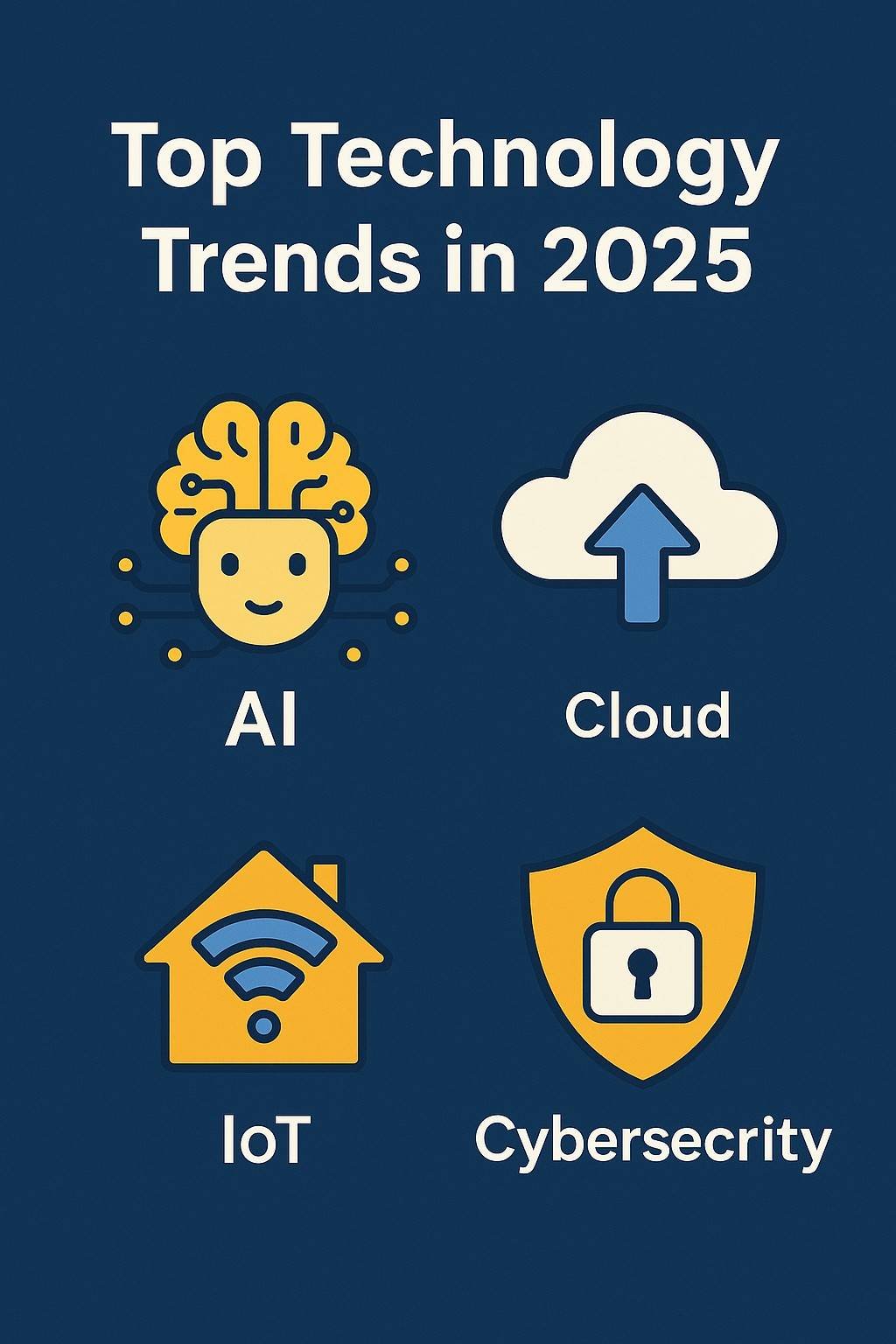
The year 2025 marks a turning point in how businesses, governments, and individuals use technology. From AI tools transforming daily work to cloud computing driving scalability and cybersecurity becoming a global priority, the pace of innovation is faster than ever. In this article, we’ll explore the top technology trends of 2025 and how they’re shaping the digital future.
1. Artificial Intelligence (AI) Tools 2025
AI technology has moved beyond chatbots and basic automation. In 2025, companies are using AI-driven analytics, generative AI, and predictive modeling to make better business decisions. Popular AI tools in 2025 are helping organizations save time, reduce costs, and improve customer experiences.
- Generative AI creating content, designs, and software code.
- AI in business for decision-making, forecasting, and HR automation.
- AI cybersecurity tools detecting threats faster than humans.
2. Cloud Computing: The Future of Business Infrastructure
Cloud adoption is accelerating in 2025 as companies move away from expensive on-premises systems. Hybrid cloud solutions and multi-cloud strategies are becoming the norm, enabling organizations to scale quickly while maintaining security.
- Cloud-based SaaS platforms dominate enterprise applications.
- Edge computing enhances IoT device performance.
- AI + Cloud integration enables smarter, faster business operations.
3. Cybersecurity Trends in 2025
As digital adoption grows, so do cybersecurity risks. Businesses are investing heavily in zero-trust security models, AI-driven threat detection, and cloud-native security platforms. The rise of ransomware attacks has made cybersecurity one of the highest priorities in 2025.
- Zero Trust Security: Protecting users, apps, and devices everywhere.
- AI-driven threat detection monitors real-time suspicious activity.
- Cyber insurance is becoming a standard business requirement.
4. Internet of Things (IoT) and Smart Devices
By 2025, the number of connected devices is expected to exceed 30 billion worldwide. From smart homes to industrial IoT, connected devices are generating massive amounts of data that fuel AI-driven decision-making.
- IoT in healthcare improves patient monitoring.
- Smart factories boost industrial automation.
- Connected cars with 5G-enabled navigation and safety features.
5. 5G and the Next Wave of Connectivity
5G adoption is enabling faster communication, lower latency, and new applications in gaming, AR/VR, and autonomous vehicles. By 2025, most developed nations will rely on 5G as their standard for connectivity.
- 5G-enabled IoT devices offer real-time data exchange.
- AR/VR technologies enhance gaming, education, and remote work.
- Autonomous vehicles benefit from high-speed, low-latency 5G networks.
6. SaaS Platforms and Digital Transformation
Software-as-a-Service (SaaS) platforms continue to lead the way in digital transformation. In 2025, businesses are moving toward AI-powered SaaS applications that simplify workflows and reduce dependency on IT teams.
- AI-driven SaaS for HR, sales, and customer support.
- Collaboration platforms designed for hybrid workforces.
- Automation tools that integrate seamlessly across systems.
Conclusion: The Future of Technology in 2025
Technology in 2025 is no longer just about efficiency—it’s about innovation, security, and inclusivity. With AI tools, cloud computing, cybersecurity, IoT, 5G, and SaaS platforms converging, businesses must embrace these trends to remain competitive. The future belongs to organizations that adapt quickly and leverage the latest technology to deliver smarter, faster, and safer solutions.